Friday, 13 December 2013

                                                         The Tottenham Riots
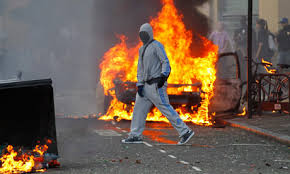
Britain witnessed unprecedented  riots during the four days riots of 2011. Numerous young people took to the streets  to demonstrate their anger and frustration on the Government and the police this led to wanton destruction of properties and looting of goods. Many reasons were adduced for the rioting that occurred  during that period. This blog post will examine the possible causes and effects of the riots.
              
Mark Duggan 


A variety of issues prevail as the warrant for the riots, one of the most influential factors that contributed to the ignition of  the  protest was the shooting of Mark Duggan in Tottenham by the police, witnesses claimed that the young man was unarmed as at the time he was shootMany of the rioters  claimed that they were targets of police in raids and  young people mostly coloured were killed by the police at the slightest provocation. This motivated them to seek revenge against the police. Policing was mentioned   by some  of the rioters as one of the precipitating factors to the crisis. These  rioters also claimed that the way police conducted the stop  and search exacerbated the protest. This obviously deepened the entrenched animosity between the local communities and the police. This motivated them to seek revenge against the police. This also brings in the question of race which might have been a factor too.

Poverty could as be presumed as a contributing factor, many of  the rioters interviewed after the riots were from relatively from poor areas who sought to vent their frustrations on the shops, this could be linked to the high level of unemployment.  This apparently means that  unemployment  may have played a key role in the riots that occurred . Many of the protesters that engaged in the riots were probably unemployed as their unemployment status precipitated availability for the the riots. According  to Lewis (2011) "of those[the rioters] who were not in education  and were of working  of working age 59% unemployed"
Although many believe a miscellany of  issues like increase in tuition fees, abolition of the student maintenance fees and economic injustice could also be a factor. Some of the rioters argued that these benefits should not have been stooped considering it was something enjoyed previously and it cause them more hardship. 
Many also perceived the riots as opportunity to to acquire goods and property  that they had previously yearned for. As a result of the breakdown of law and order people capitalized on the shortfall in security to loot  big shops.
However some of the effects of the riots are numerous but this blog will consider a few. The damage was colossal on businesses as several were torched by the rioters. Many shops within affected areas lost huge amount of money to the riots that engulfed  the country, Many shops were broken into some were razed to the ground. The insurance claims were high according to the London School of Political Science " the cost of insurance claim only on London economy alone was estimated to was estimated to be £300 million" 
Another effect of the riot is it highlighted the ability to effectively coordinate unrest with the social media especially with networks like the Black Berry Mobile (BBM). Most of rioters were able to congregate at various locations without being spotted by the police because most the messages were dispersed by using the BBM network in contrast to the held idea that twitter and face book were used. 
The riots increased prejudiced towards  coloured people many white people viewed them as the cause the cause of the riots also  the riots lead to wanton arrest  and detention of many people. 
For further informations http://www.theguardian.com/uk/2011/dec/05/anger-police-fuelled-riots-study,
http://eprints.lse.ac.uk/46297/1/Reading%20the%20riots(published).pdf

References
 Lewis,  P (2011) 'Reading the Riot'  The guardian (2011) [On line]. Available at: www.theguardian.com/uk/series/reading-the-riots (Accessed 8 December 2013)

The  London School of Economics and Political Science (2011) Reading the Riots Available at: www/eprints,ise.ac.uk/46297/1/Reading%20the%20%riots (Accessed 8 December 2013)
The United kingdom as diverse society 

The Portuguese language is one of the popular languages today. Over a two hundred  million people speak Portuguese but only 10 million of the specified number live in the Portugal. These occurred as a result of the colonial history of the country. The Portuguese empire stretched from the fifteen to the late twentieth centuries.Majority of the her citizens arrived UK  between 1960s and 1970s.
Demonstration against Portugal in Angola, Mozambique and Guinea-Bissau in Stockholm, Sweden in the 1970s.

During the the early 1970s  Portugal was one of the poorest countries in the Europe. Their economy grew from bad to worst. The manufacturing sector was struggling  so offered few opportunities to the ordinary people. Furthermore many young people fled the country to avoid conscription as the Portuguese army was involved in series of wars to hold on to their colonies. Majority of the Portuguese speaking population are domiciled in Kingston, Chelsea,Lambeth and Westminster. Portuguese  is one of the language of the European Union. In the past decade the Portuguese  population has increasingly contributed to the culture and the economy of Britain especially in regard sports.


The  English premier league has paraded  a number of Portuguese players and Club managers . The most prominent is Christiano Ronaldo who was the first player from the English Premier League to win the coveted award  the world footballer of the year while he was still playing at Manchester United.
For further information visit http://www.bbc.co.uk/voices/multilingual/portuguese_history.shtml#A

Friday, 8 November 2013

Reflection on the visit to the National Assembly For Wales. The Senedd a land mark building.


The Senedd Building


The visit to the Senedd building was remarkable.The students had the opportunity to witness a session, during the sessions the legislatures debated on several bills ranging from bills to improve the transport systems within Cardiff to improving the quality of health care. The tour guide apprised the students of significant facts about the Senedd.

The Mace of the Senedd 


The guide noted that the glass art work situated at the centre of the Simbr is called the "Heart of Wales" designed by a Swansea based artist Alexander Beleschenko. The guide further stated the mace is made from gold,silver and brass and was a gift from the parliament of of New South Wales Australia. The mace was presented at the royal opening of the of the Senedd in 1st March 2006. In addition the students were also informed that the total cost of the building was £70 million, over £14 million worth of materials was sourced from Wales. The steel roof is made of 421 tonnes of steel with 21900  bolts with 2088 connections. In summary the trip was successful the students had opportunity to visit Cardiff Bay which over looks the Senedd.    
History of Wales Assembly and devolution of power.

When the labour party won elections in May 1997 part of their manifesto was to hold a referendum in Wales as published in the White paper (voice of Wales). The referendum was held and the people decided on (a) to agree that their should b a Welsh Assembly (b) do not agree that there should be a Welsh Assembly .Out of the 50.1% of voters that turned up for the referendum held in May 1997 50.3% supported establishing a new assembly a slim majority of 6721 votes.


                                           http://www.youtube.com/watch?v=3ha8o7Gd6HY


 The first elections to the new institution was held in 6 may 1999. As a result of difficulties which the assembly encountered during its inception demands for changes were made to permit distinct powers for the executive and legislature.The legal separation of the executive and the legislature was established as suggested by the Richard commission. In 2004 the Richard commission also recommended that the powers of the Assembly be strengthened because it lacked the capacity to perform effectively, following the recommendation an act was introduced  "The Government of Wales Act 2006" which permitted the assembly to gain more power in devolved areas.

 According to the "Government of Wales Act 2006" the Welsh government would consist of the First Minister, Welsh Minister, Deputy Minster, and Counsel General. They are saddled with the responsibility of implementing polices. The National assembly consist of 60 elected members from their respective constituencies. They scrutinize the Ministers and the Government. The 2007 elections was officially introduced by the new act. After the elections the  Labour  and Plaid Cymru formed a coalition to pursue full law making powers through a referendum.


 The Welsh electorate voted in favour of full law making powers in March 3 2011. In all the 23 local authority areas 22 areas voted yes but 1, the 5th of may 2011 the assembly assumed full powers. The referendum was significant because it was set out to ask the voters if the Assembly should progress  to the part four of the Government of Wales act which spells out the full extent of the law according to BBC (2011). BBC also reported that the turn out was very low with an overall result of "yes votes 517,132 ,63% no votes of  297,380, 36.5%  turn out 35.4%".Before the referendum all laws passed in Cardiff were subject to accent from Westminster on a case by case basis through a Legislative Competence Order. The Assembly has passed several bills since inception, on 10 September 2013 the assembly passed a bill introduced by Lesley Griffith Am, Minister for Health and Social services. The bill is titled "Human transplantation Wales". The bill increases the availability of more organs and tissues for transplant by introduction of a self opt - out system of organ and tissue donation in Wales
Further information on the Welsh Assembly visit http://wales.gov.uk/?lang=en http://www.assemblywales.org/,  http://www.assemblywales.org/

References

BBC (2011) Wales say yes in a referendum vote. Available at http://www.bbc,co.uk/news/ (Accessed 3 November 2013)

National Assembly for Wales (2013) The history of welsh assembly. Available at http://www.assemblywales.org/...of assembly.../history-welsh-devolution.htm ( Accessed 3 November 2013)

DIFFERENCE BETWEEN GOVERNMENT AND PARLIAMENT IN THE UK

THE DIFFERENCES BETWEEN THE GOVERNMENT AND THE PARLIAMENT IN THE UK

The two main organs of governance in UK are The Government and The Parliament. These two organs of government have very distinct roles and responsibility.

Government bears the onus to manage the resources of the country. Government also decides how the money is disbursed through its various departments.

Prime minister  and  the Cabinet

 In addition government's duty includes to implement policies and draft laws, most of the bills drafted by government are transferred to the legislature for debate.The Government is also known as the executive  . The primary and cardinal  responsibility of government is to protect and secure the lives of the citizen employing all constitutional and legal authority bestowed on it by the laws of the land. The  Government constitutes of the prime minister,the leader of the largest party in the parliament or a coalition of parties, select team of members of the parliament and house of commons and a host of ministers and politically  appointed members

MPs

On the other hand the Parliaments primary role is to make legislation, the parliament debates on bills and drafts then passes them into law. The parliament critically investigates all details of the activities of government.


Lords 


 Parliament is the highest legislative body in the UK. They also have the power to raise taxes to enable government to meet her obligations. The parliament comprises of the house of lords and  house of commons they are 650 MPs  elected by the various constituency.


References
.
The Home Office (2013) How Government Works Available at: http://www.gov.uk/ (Accessed : 28 October 2013)

The UK Parliament (2013) MPs Lords and Offices Available at http://www.parliament .uk/ (Accessed: 28 October 2013)

Compare the education in Nigeria and in the UK


     COMPARE THE EDUCATION SYSTEM IN THE NIGERIA AND IN THE UK
The education system in Nigeria is very inconsistent. Nigeria's educational system has endured  multitude of changes in the past three decades as a consequence of incoherent polices and programmes of the past and present governments of the country. After the country gained independence in 1960 the Government took over education from the missionaries without the adequate expertise, these vicissitudes  impacted negatively  on the quality and standard of education manifest in the country presently.On the hand the United Kingdom (UK) has steadily evolved  from ordinary mission owned schools to world standard educational system, that can compete firmly with contemporary educational systems all over the world. The UK is reputed as one of the model educational system in the world today. This blog task will juxtapose the education system in Nigeria and the UK .
The current education system /structure in Nigeria was introduce in 1985, the system is called the 6-3-3-4 system. It is separated into four main categories 

Pre - Primary Education. Children within the ages of  3 - 5 years attend pre-primary school. All pre-primary schools are owned by private institutions and individuals.
Primary Education. This sector includes children within the age bracket of 6-11 years.This is the formation period for children in Nigeria.The constitutional requirement provides every child with the right to primary education invariably the government has the constitutional role to provide every child with primary education. The private sector and individuals play significant roles in the primary  education because majority of the state run schools are decrepit and blighted
Secondary Education . This refers to the to children within 12 years and above. The secondary school is classified into two categories junior secondary school  (3 years) and senior secondary school (3 years). According to the compulsory free universal basic act (2004) part (1 no 2) "Every Government in Nigeria shall provide free,compulsory and universal basic education for every child of primary and junior secondary school age". Afterwards the family is responsible the child's education .
Higher Education This is the pinnacle of learning in Nigeria. Students graduating from the secondary schools are expected to continue their education for 4 - 6 years depending on the degree pursed at higher education level. The higher education includes universities, polytechnics, colleges of technology and colleges of education.
Further more the provide the government provides special education for handicapped children that find learning difficult due to disabilities .


On the other hand the education system in the United Kingdom consist of four major sectors

Pre-School Education  This is the foundation stage, children within the age bracket 3 - 5 years attend it. Children are provided with free part time education at the level of the pre -schooling. This lays the foundation upon which further education is built upon.
Primary Education Children within the age 5 - 11 years attend the primary school. Many primary schools in the UK are maintained by the state. However their are independent fee paying schools. In addition all the state maintained schools constitute school governing body in tandem with the constitution specified in the instrument of  government. The conditions include ( i )"Parent governors elected by parents with children at the school  ( ii ) Staff governors which includes the headteacher, at least one teacher and, where relevant, another member of staff. These governors are elected by the staff at the school (iv) Community governors who are appointed by the governing body" Weedon et al (2010)


Secondary School   Children within the age of 11-16 secondary school. Secondary school education is classified into two stages. The secondary also comprise of the sixth form colleges or further colleges, it is also called middle school in some areas. The sixth form colleges provides "young people with a wide choice of programmes leading to general/academic,pre-vocational or vocational qualification" Weedon et al (2010)
Higher Education Higher education in the UK varies depending on location, history and purpose. Many higher education school are designed to meet specific needs. Higher education is funded independently though often they may access public funds. They derive majority of their funds from student fees, research grants and developing business ideas.
In conclusion the education system /structure in Nigeria is similar to the system/structure in the in the UK with exception of the further education practised in the UK. The universities in UK are independently run by the institutions which varies from their counterparts in Nigeria. It is also pertinent to note that the university system in the UK has evolved rapidly because the government has assiduously pursued good policies that grant universities autonomy enabling them to adopt and meet the gaols designed by the institutions. We must also take cognizance that Britain was the colonial masters of Nigeria, the educational system practised in Nigeria is an off shoot of the system bequeathed to Nigeria by Britain. Further information visit : http://worldroom.tamu.edu/Workshops/Africa07/Nigeria/Education,%20Unemployment%20and%20Economic%20growth.pdf.http://www.docs.hss.ed.ac.uk/education/creid/Reports/32_MFEES_FinalRpt.pdf

Reference
Ajetomobi J & Ayananwalle,A(2005)Education,Allocation,Unemployment,and Economy growth in Nigeria. Available at http://www. worldroom.tamu.edu/.../Nigeriaeducation,%20unemployment.(Accessed 13October 2013)

Weedon, E et al (2010) Muslim pupils Educational Experience in England and Scotland.Available at http://www.docs.hss.ed.ac.uk/education/creid/Repot/31_MFEES_finalRpt.pdf (Accessed 11 October 2013).

National Foundation for Education Research (2013).Description of Education system in England Scotland and Northern Ireland.Available at http://www.nfer.ac.uk/nfer/index.cfm?73DA0842-C29E
-AD4D.09B9-F45A781F13BD(Accessed 12 October 2013)

The Embassy of Nigeria South Korea (2010) Education Available at  http://www.nigerianembassy.or..kr/nigeria/education.asp (Accessed 12 October 2013)

Saturday, 12 October 2013

Symbolic significance of the different flags of the United

Symbolic significance of the different flags of the United Kingdom


THE UNITED KINGDOM 
The national flag of the United Kingdom is a union of all the different flags of the kingdoms that exist within its territory. The flag is commonly known as the Union Jack. The original design date back to to1606 at the behest of James V1 &amp 1 who demanded for a flag for the his newly united Kingdom of Great Britain. In 1806 the present design was introduced. All the kingdoms in the United Kingdom (Scotland, England, Northern Ireland) were represented with the exception of Wales. Wales was a principality as at when the flag was created.


 ENGLAND
 The flag of England represents the Red Cross marked on the surcoats of the early crusaders. The crusade was made very popular by Saint George, who became famous after the crusade and brought back the cult with them.


 SCOTLAND
 The flag of Scotland has its roots in the battle of Athelstanford during the 9th century. The Pictish king Angus Macfergus praised St Andrew for his victory over the Saxon Athelstan. Legend claims that the cloud displayed a white cross in the sky to show the support of St Andrew for the Pict and the Saxons lost heart. The Scottish flag is a saltire of St Andrew.


 WALES 
The Welsh flag has a prominent feature of the “The Red Dragon” Y Draig Goch. The dragon is a symbol of the royal prince of 4th and 7th century Cadwaldar,prince of Gwyned . The dragon became a symbol of the principality at the behest of the prince. The green and white were colours of the welsh prince of Liewellyn . 


Northern Ireland
 The flag is almost a replica of the flag of England and province of Ulster with an incorporation of a crown that is emblematic of the loyalty of the Ulster unionist to the British Monarchy. Strong dispute exist in regard the meaning of the star some say it is the star of David others say it represents the six counties that make up the Northern Ireland.